
white paper

The Surprising Science Behind Red-Light Therapy — and How it Really Works

Abstract

People are buying helmets, face masks, vests and beds that emit long-wavelength light. Beneath the hype, there is some interesting biology.

In 2021, dermatologist David Ozog was on holiday with his family in the Bahamas, when his 18-year-old son had a massive stroke. The teenager was airlifted to Florida, and then to Chicago for surgery. As his son was lying partially paralysed in a hospital bed, Ozog got a call from a colleague who had an unconventional suggestion.

The colleague, a dermatologist at Harvard Medical School in Boston, Massachusetts, told Ozog about research he was conducting with the US Department of Defense. Early results hinted that red and near-infrared light applied to the head might protect neural tissue after brain injury. He urged Ozog to consider trying it on his son.

Ozog stayed up until 4 a.m. that night reading scientific papers and, ultimately, ordering several panels made of red and near-infrared light-emitting diodes (LEDs). “I started sneaking them into the hospital,” says Ozog, who works at Henry Ford Health in Detroit, Michigan.

Today, his son is walking and back in university. Ozog cannot prove that light therapy made a difference, but he thinks that it helped. He has since become a convert to an idea that, at the time, was considered fringe. “I thought the same thing,” he says, “How could shining this thing on you possibly have any biologic effect?”

Read More or download the PDF.

LindellTV

110 Million Patients. Zero Documented Side Effects.

white paper

Red Light Therapy Might Protect Football Players From Brain Damage

Abstract

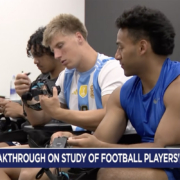
WEDNESDAY, Jan. 28, 2026 (HealthDay News) — Red light therapy might be able to protect football players from brain damage caused by frequent head impacts, a new small-scale study says.

College football players treated with red light therapy over the course of a season wound up with much less brain inflammation than others provided a placebo treatment, researchers recently reported in the Journal of Neurotrauma.

In fact, the study found that the group receiving red light therapy appeared protected from inflammation throughout almost all the regions of the brain.

“My first reaction was, ‘There’s no way this can be real,’ ” lead investigator Hannah Lindsey, a research associate in neurology at University of Utah Health, said in a news release. “That’s how striking it was.”

Red light therapy involves exposing a person to powerful near-infrared light, researchers said in background notes.

The therapy is thought to activate mitochondria, the “power plant” within the body’s cells, thus stimulating cells to work more efficiently.

Read More on healthday.com or download the PDF.

white paper

Already-Available Therapy Could Protect Football Players from CTE: ‘Incredibly groundbreaking’

Abstract

Forget reducing wrinkles and fighting hair loss.

A new study suggests a unique form of a treatment already popular in the US for skin health, pain relief and faster healing may also offer a surprising benefit: Protecting football players’ brains from chronic inflammation caused by repeated blows to the head.

“I would call it incredibly groundbreaking,” Dr. Shae Datta, co-director of the NYU Langone Concussion Center, who was not involved in the research, told The Post.

While it hasn’t been put to the test yet, experts hope red light therapy may one day offer a valuable tool in the fight against the deadly brain disease known as Chronic Traumatic Encephalopathy, or CTE.

The degenerative brain disease is caused by repeated head injuries and is most common in contact sports athletes like football players and boxers, as well as soldiers in war zones.

It can lead to a wide range of symptoms, including confusion, memory loss, emotional instability, aggression and, eventually, trouble walking, speaking, swallowing and even breathing. There’s no cure, and doctors don’t know how to slow its progression.

Right now, the only real way to prevent CTE is to avoid repeated brain injuries by wearing helmets and reducing hits to the head.

But with more than 100 former NFL players diagnosed with CTE after death and countless others likely affected, experts say additional tools are needed.

“We don’t have enough information to say that using this could prevent CTE,” Datta said. “But we can say it’s a potential use for it if it’s bringing down neuroinflammation, because that’s what’s causing the long term effects.”

Read More on nypost.com or download the PDF.

white paper

Preventable Tragedies

Abstract

The horrific murders of Rob Reiner and his wife, Michele, by their son are made more tragic because they were preventable.

Nick Reiner, Rob’s son, began his downward spiral to murder at age 15. His eighteen attempts at failed rehabilitation are typical of the 1.36 million patients going through Rehabilitation Programs to address their Substance Use Disorder (SUD).

Drug Rehabilitation is now a $35 billion global industry. Americans spent $9.44 billion on patient rehabilitation treatments in 2024. U.S. Rehab spending is expected to rise to $16.22 billion by 2033. Another $1.5 billion is allocated in Federal grants for Opioid Response Programs.

Approximately 60 percent of those who complete rehab programs relapse into addiction. Only 43 percent of those who enter rehab programs complete their treatment.

These multiple levels of failure have only motivated government and private foundations to spend more money pursuing the same approaches. How many more lives will be lost before there is meaningful change?

It does not have to be this way.

Read More on citizenoversight.blogspot.com or download the PDF.

white paper

Does Red-Light Therapy Work?

Abstract

Follow any beauty biohacker on social media right now and you’ll hear them raving about the benefits of

As an increasingly popular longevity tool, red-light therapy is said to help improve skin and hair health, enhance cellular vitality, and reverse the signs of aging. While there is evidence to support the claims of red-light therapy, studies are limited. To discover best practice when it comes to red-light therapy and how to make it work into our everyday lives, we asked the experts to share insight into its effectiveness.

Read More on wired.com or download the PDF.

white paper

For those living with long-term brain injuries, a new therapy may offer a path forward

Abstract

SACRAMENTO, Calif. — Rico Petrini remembers the early days of high school football — the excitement, the intensity and the hits that came with playing linebacker. Back then, he said, getting “your bell rung” was something teammates laughed about.

“I probably had at least 8 to 10 concussions in high school,” Petrini said. “We used to laugh about, oh, he’s seeing stars.”

Football was more than a sport for him. He studied it, lived it, and eventually drew the attention of more than 100 colleges. He chose Oregon State, but by the time he stepped onto the field there, he said the damage had already piled up.

Read More on abc10.com or download the PDF.

The People and Hope of MAHA

Gibby Media Group